
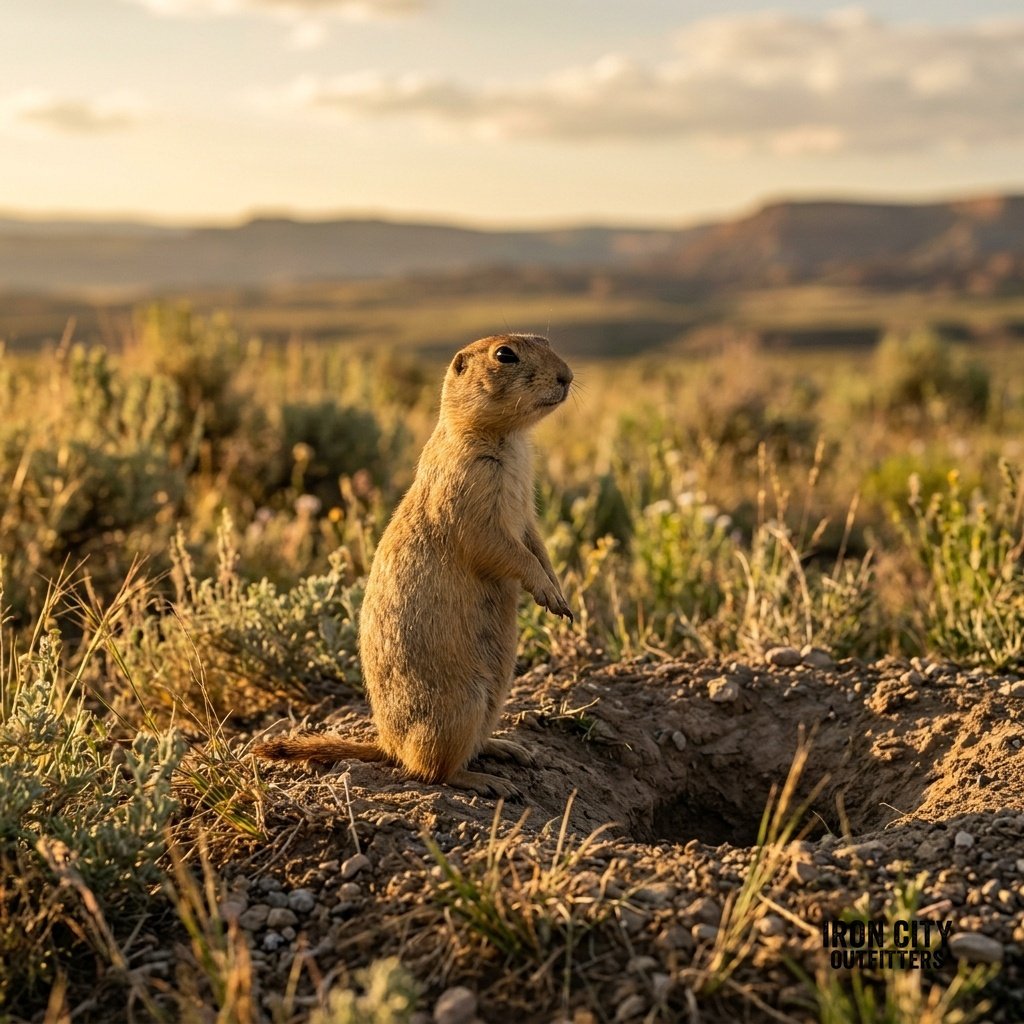
Six months of daylight. Six months sealed underground in frozen dark, heart rate slowed to a crawl, core temperature driven toward the edge of survival. This is the annual gamble facing the Utah prairie dog (Cynomys parvidens), the smallest and rarest of North America’s five prairie dog species, found nowhere on Earth outside the high plateaus of south-central Utah.
Weighing barely more than a can of soda, the Utah prairie dog measures survival in inches of topsoil and degrees of frost. Unlike lowland relatives that forage nearly year-round, this species retreats into hibernation for up to half the calendar year, sometimes as early as July at the highest elevations. Torpor drops metabolic rate and body temperature to a fraction of normal function, a physiological tightrope walked to outlast subzero winters across elevations between 6,000 and 9,500 feet.
Aboveground existence unfolds inside complex burrow colonies excavated through meadow and sagebrush-grassland soil, structures engineered to regulate temperature, evade predators, and shelter young. A single colony functions as an underground city, built layer by layer to resist collapse and flooding alike. These burrows extend value far beyond one species; abandoned tunnels become refuge for burrowing owls, toads, and countless invertebrates, establishing the Utah prairie dog as a keystone architect of the surrounding grassland ecosystem.
Communication relies on a sharp, layered vocabulary of barks and chirps, with distinct calls reserved for aerial predators such as hawks versus ground threats like badgers and coyotes. Foraging strategy centers on grasses, forbs, and seeds, consumed in short, vigilant bursts near burrow entrances, under constant sentry duty against golden eagles patrolling the open plateau sky.
Federally listed as threatened, the species survives today across a fraction of the historic range spanning Garfield, Iron, Kane, Piute, Sevier, and Wayne counties, following twentieth-century population crashes driven by poisoning campaigns and sylvatic plague outbreaks. Recovery efforts now concentrate on translocated colonies and protected grassland habitat, including populations observable within Bryce Canyon National Park.
Encountering an active colony means witnessing a fragile equilibrium: extreme seasonal dormancy balanced against a narrowing window of habitat, ground still held on the high plateaus claimed since the retreat of ice age glaciers.
Assisted by AI; content may contain inaccuracies.