
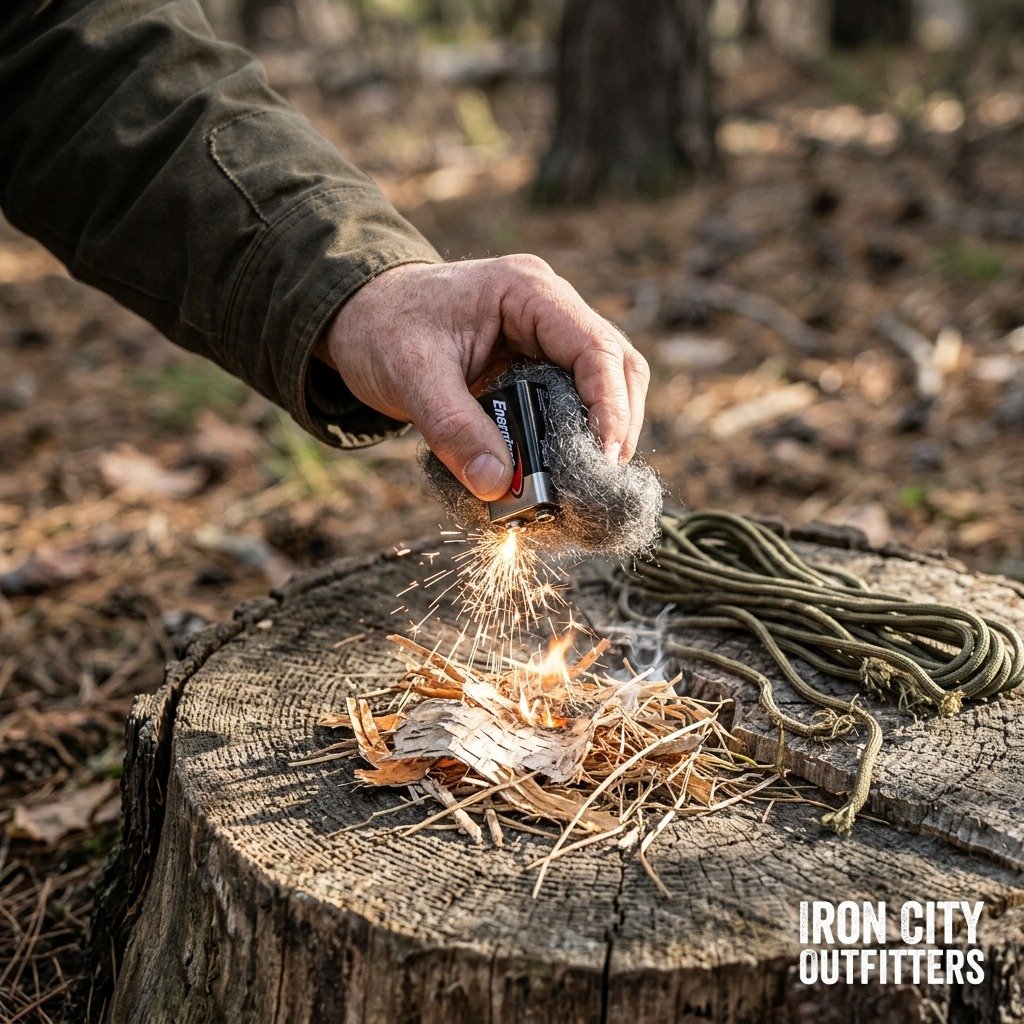
A dead battery looks like trash. In a whiteout, a flash flood, or a sudden temperature crash after sunset, that same “dead” cell is the difference between a controlled camp and a hypothermia emergency. Most electrical charge doesn’t vanish when a device stops powering on — it simply drops below the voltage threshold a circuit board needs. There is almost always enough stored energy left to bridge a wire and generate combustion-grade heat. Recognizing that distinction, fast, is a core backcountry survival skill.
The mechanism is pure physics: electrical resistance. Fine-gauge steel wool (0000 grade, the finest commercial cut) is composed of dozens of hair-thin steel filaments. Each filament carries only a small cross-sectional area, so when a load is forced through it, resistive heating spikes rapidly at the thinnest points. Push current from two battery terminals into opposite ends of a wad of steel wool, and the filaments at the contact points heat past 1,500°F almost instantly, igniting into a self-sustaining shower of sparks. That shower is hot enough to catch dry tinder in under ten seconds — no flint, no lighter fluid, no friction drilling required.
[Click Here to Copy This Survival Protocol & Field Checklist]
Success depends entirely on preparation before the terminals ever touch. Tinder must be bone-dry and processed into fine material — char cloth, dry inner bark fibers, dryer lint, or fatwood shavings all work. Damp tinder absorbs the spark shower’s heat before a flame can establish, wasting a battery’s remaining charge, which is finite and non-rechargeable in the field. Contact duration also matters: holding the connection too long drains the cell without added benefit, since ignition either happens in the first few seconds of sustained contact or it does not happen at all.
9-volt batteries are the ideal candidate because both terminals sit flush on the same face, allowing direct contact with a single motion. AA, AAA, C, and D cells work as well but require bridging both ends of two or more cells in series, or touching the wool directly across a single cell’s positive and negative poles. Lithium and alkaline chemistries both perform; the technique fails only on cells that are fully, chemically dead rather than merely below operating voltage — a distinction worth testing on multiple discarded cells before an emergency arises.
Full Protocol & Field Checklist
- Stage the tinder bundle first. Build a loose bird’s-nest shape from the driest available fibrous material, sized to a fist, with a hollow center.
- Pull a wad of 0000 steel wool roughly the size of a golf ball. Stretch and fluff it slightly to expose maximum surface area without breaking continuity between strands.
- Isolate the battery terminals. Identify positive and negative contacts. On cylindrical cells, note which end is flat (negative) and which has the raised nub (positive).
- Make contact. Press the steel wool firmly across both terminals simultaneously. Sparks and glowing filaments should appear within one to two seconds.
- Transfer immediately. The moment ignition catches, drop or press the glowing wool into the center of the tinder bundle without delay.
- Feed oxygen, not panic. Cup hands loosely around the bundle and blow steady, low breaths from underneath to grow the ember into open flame.
- Build up in stages. Add pencil-thin dry twigs first, then progressively thicker fuel, maintaining airflow throughout.
- Store spent components. A used battery may still ignite a second or third time at reduced reliability — retain it rather than discarding it.
Assisted by AI; content may contain inaccuracies.