
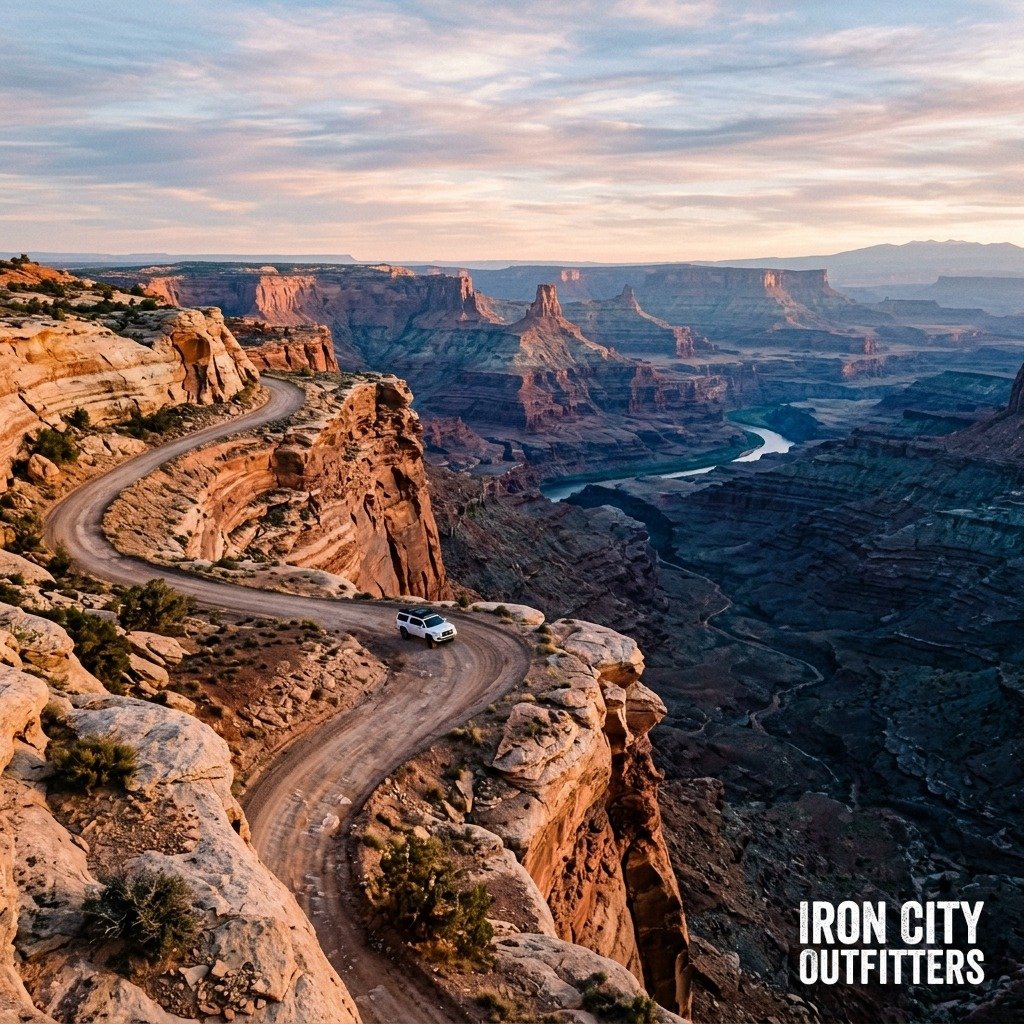
Twelve hundred feet down, the Green and Colorado rivers carve a table of sandstone so vast that the rim disappears into heat shimmer before the eye finds an edge. This is the White Rim: a hundred-mile shelf road cut into the belly of Canyonlands National Park, suspended between the mesa above and the inner gorge below, where no cell signal, no shade structure, and no easy exit exist for nearly the entire circuit.
The White Rim Trail is not a hike — it is a multi-day 4×4 or mountain-bike traverse across a bench of Permian-era White Rim Sandstone, wrapped almost entirely around the Island in the Sky district. Access begins near the Shafer Trail switchbacks, a series of blind, unguardrailed hairpins blasted into the cliff face that drop nearly 1,200 feet in nine-tenths of a mile before the route levels onto the rim proper.
Once on the bench, exposure becomes the defining hazard. Daytime temperatures on the slickrock regularly exceed those recorded at the visitor center above, radiating off pale sandstone with almost no vegetation to interrupt it. Water sources are nonexistent along the route; every gallon consumed over the typically three-to-four-day crossing must be hauled in, a logistical constraint that has turned back more parties than any technical obstacle on the road itself. Sand traps near Hardscrabble Bottom and the loose, rock-armored climb at Murphy Hogback demand low-range gearing and tire pressure discipline; a stalled vehicle or a snapped chain on the Hogback’s switchbacks sits hours from any paved access.
Below the rim, the inner canyon drops away in sheer red-rock walls toward the rivers, close enough to hear rapids at certain overlooks but functionally unreachable without technical rope work — a reminder that the White Rim occupies a narrow shelf between two much deeper systems, the plateau above and the river gorge below, both indifferent to the traveler moving across the bench in between.
Permits are required for overnight camping along the route and are allocated through a competitive reservation system well before the travel season opens. Vehicles must be high-clearance 4WD; standard mountain bikes require a full support vehicle given the water and gear demands. Flash flood risk closes sections of the route without warning during summer monsoon windows, and rangers strongly discourage travel between roughly May and September due to heat exposure alone.
What the White Rim offers in return is uninterrupted geologic exposure — a hundred-mile cross-section of the Colorado Plateau’s layered history, visible in a single continuous traverse rarely matched elsewhere in the canyon country.
Assisted by AI; content may contain inaccuracies.