
A clean stream ninety minutes ago is now a stagnant, algae-slicked pool the color of weak coffee. The last liter of bottled water is gone. Giardia, cryptosporidium, and a dozen other waterborne pathogens do not announce themselves — they wait forty-eight to seventy-two hours, then arrive as violent dehydration in a location with no cell signal and no extraction route. In a survival contingency, water quantity is never the limiting factor. Water quality is. And quality can be engineered from what the terrain already provides.
The charcoal-and-sand cascade filter exploits three separate mechanical and chemical processes stacked in sequence, and each layer earns its position in the column for a specific reason.
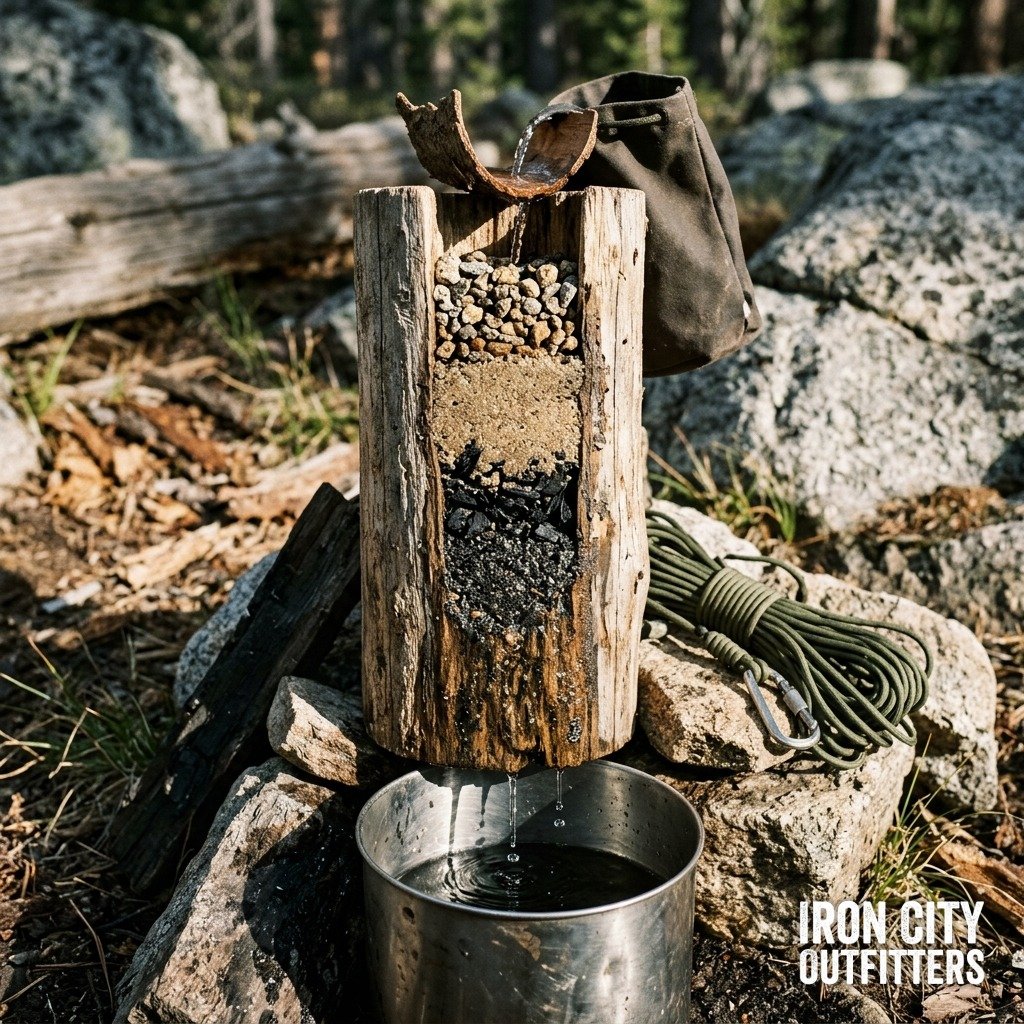
Layer one — coarse gravel: strains large sediment, leaf matter, and insect debris, preventing clogging of the layers beneath it. Layer two — fine sand: traps suspended particulates down to roughly 10–15 microns through mechanical sieving and surface adhesion, the same principle municipal slow-sand filtration plants rely on. Layer three — crushed hardwood charcoal: this is the critical stage. Charcoal produced by incomplete combustion develops a porous carbon lattice with a surface area exceeding 300 square meters per gram. That lattice adsorbs organic compounds, certain heavy metals, and a portion of dissolved contaminants through van der Waals attraction, pulling molecules out of solution and locking them to the carbon surface.
Stacked in a hollowed log, a cut plastic bottle, or a rolled section of birch bark — gravel at the base for drainage, then sand, then charcoal, then a second sand layer on top to catch ash — gravity does the rest. Water poured in at the top emerges clearer, with reduced turbidity and a measurable drop in organic load.
One critical caveat: this system reduces contamination; it does not sterilize. Bacterial and viral pathogens pass through mechanical filtration at a high rate. A rolling boil for at least one minute (three minutes above 6,500 feet elevation) after filtration is non-negotiable before consumption.
[Click Here to Copy This Survival Protocol & Field Checklist]
The materials for this system exist at nearly every wilderness site in North America. The skill is knowing the sequence, the ratios, and the boil step that turns a stagnant pool from a liability into a resource.
Field Protocol & Checklist: Charcoal-Sand Cascade Filter
Materials required:
- A container with an open bottom or a punctured base (cut plastic bottle, hollow log section, birch bark cone, or bandana slung between forked sticks)
- Coarse gravel or small stones
- Fine sand (river sand or dune sand, free of large debris)
- Hardwood charcoal, crushed to pea-sized pieces (cold, fully extinguished coals from a prior fire — never fresh ash)
- A secondary catch container for filtered output
- A metal container and heat source for the mandatory boil step
Assembly sequence:
- Invert the container so the narrow or punctured end points downward into the catch vessel.
- Place a 1–2 inch layer of coarse gravel at the base to prevent clogging and support drainage.
- Add a 2–3 inch layer of fine sand directly above the gravel.
- Add a 3–4 inch layer of crushed charcoal above the sand — this is the primary adsorption layer.
- Cap with a final 2-inch layer of sand to trap ash and prevent charcoal fines from washing into the output.
- Pour contaminated water slowly into the top; allow full gravity drainage before repeating for larger volumes.
- Collect filtered output in the catch vessel.
- Transfer to a metal container and bring to a rolling boil for a minimum of 1 minute (3 minutes above 6,500 feet elevation) before any consumption.
- Allow to cool, then store in a clean, covered container.
Field notes: Replace the charcoal and sand layers after filtering 3–5 liters, or sooner if flow slows significantly. Discard and rebuild the entire filter if odor persists in the output. This system does not replace the boil step under any circumstance.
Assisted by AI; content may contain inaccuracies.