
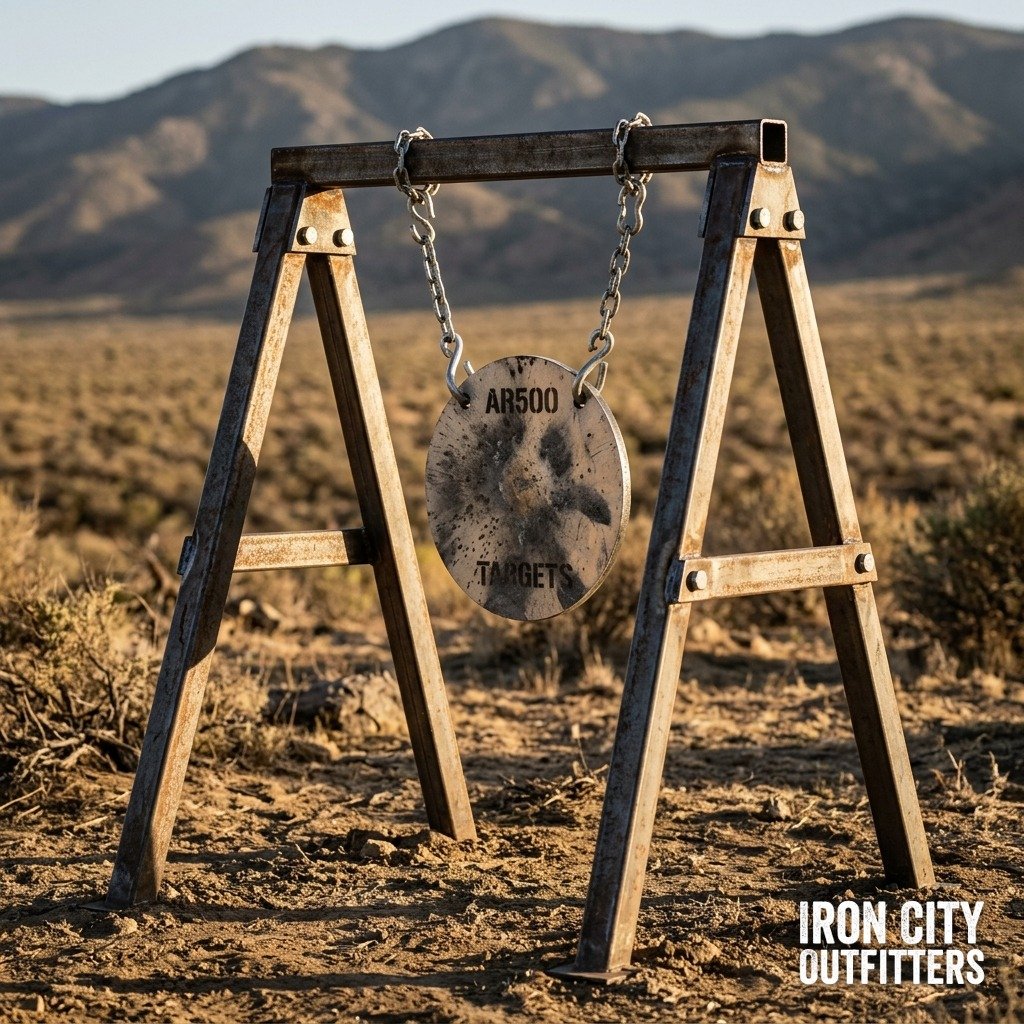
A 230-grain slug meets 3/8-inch AR500 at 950 feet per second and the exchange is over in under half a millisecond. Kinetic energy that took a full powder burn to build collapses into a shockwave that rings the plate like a struck bell, flashes a smear of vaporized copper and lead across the face, and redirects the bullet’s mass sideways and backward in a cone of spall traveling at a meaningful fraction of the original velocity. That cone is the entire safety problem. Everything else — stand geometry, hanging hardware, standoff distance — exists to control where that cone goes.
Chain and strap selection is the most overlooked variable in a steel target build. A target rigidly bolted or chained taut absorbs almost none of the impact energy through movement, forcing more of it into face spatter and accelerated pitting. Suspending the plate on a slight slack — grade-70 transport chain or heavy nylon tow strap, sized well above the plate’s static weight — lets the target swing and absorb energy kinetically instead of reflecting it. Twin-point suspension from a top rail, rather than a single center hanger, kills lateral spin and keeps the plate’s face square to the firing line shot after shot. Inspect chain links and strap stitching before every session; work-hardened links and UV-degraded webbing fail without warning, and a dropped plate at a hot range is a stopped range.
Standoff distance scales directly with muzzle energy, not caliber name alone. Common handgun calibers — 9mm, .40 S&W, .45 ACP — driving projectiles at subsonic-to-moderate velocities into 3/8-inch AR500 permit standoff distances as close as 7 to 10 yards under controlled conditions. Push into high-velocity rifle territory and that minimum extends to 100 yards or more, and no amount of gong canting substitutes for adequate distance when energy exceeds the plate’s rated threshold. Match plate thickness and hardness to the intended cartridge before match plate to a shot list, not after.
Grade-8 hardware only, torqued to specification, on every hanger bolt and bracket — mild steel fasteners shear under repeated shock loading and turn a stand into shrapnel. Steel rated below AR500 has no place downrange of centerfire rifle calibers, full stop.
The primary rules remain non-negotiable regardless of equipment quality: treat every firearm as loaded, keep the muzzle pointed in a safe direction at all times, keep fingers off the trigger until the sights are on target, and maintain absolute certainty of the target and what lies beyond it. Equipment failure is survivable. Muzzle discipline failure is not.
Assisted by AI; content may contain inaccuracies.