
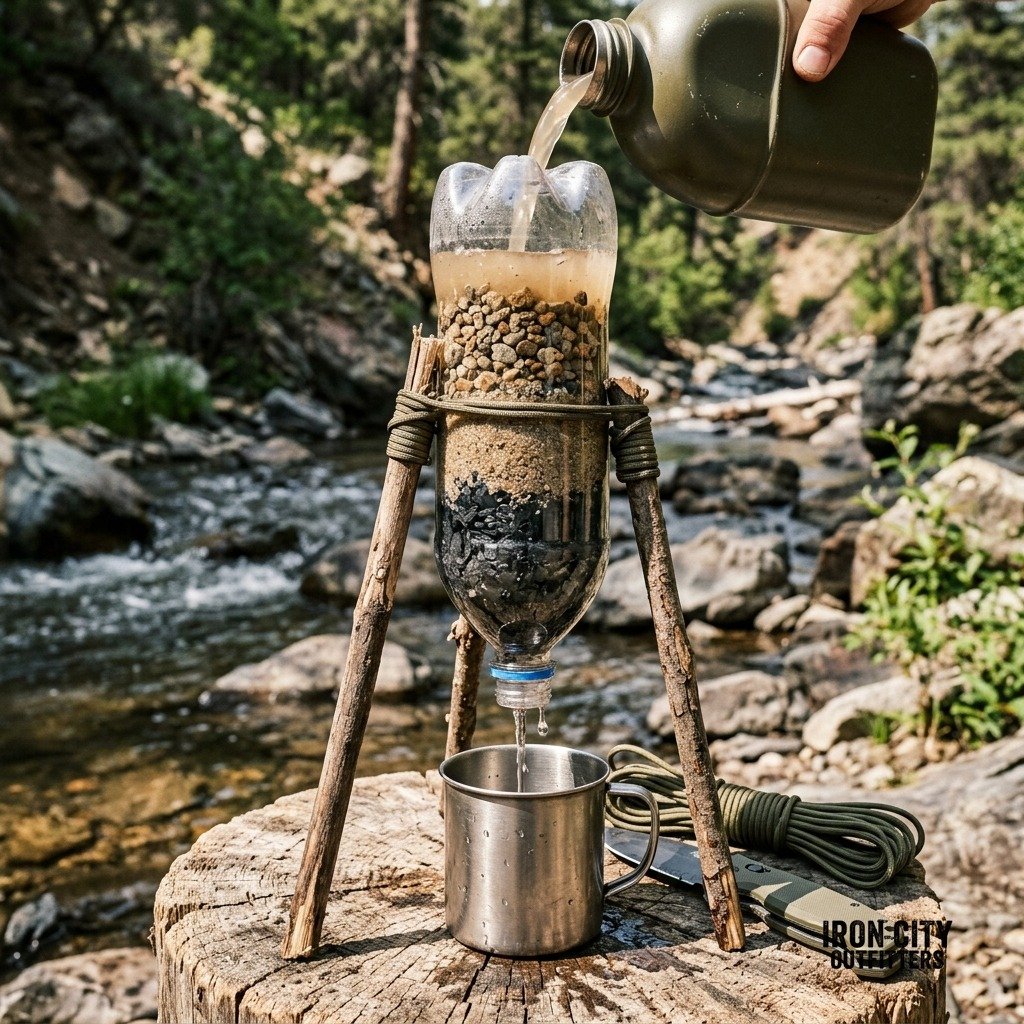
Four hours from the trailhead, the last liter of clean water disappears, and the creek ahead runs the color of tea — thick with silt, algae, and whatever waste sits upstream. Turning back costs a full day of daylight. Drinking it raw risks giardia, cryptosporidium, and a violent, dehydrating retreat from the backcountry. Between those two outcomes sits a fifteen-minute build using items already carried or found on the ground: a bottle, sand, gravel, cloth, and charred wood.
Layered filtration works on two separate physical principles stacked in sequence. Coarse gravel and pebbles strain out leaves, insects, and heavy sediment through simple mechanical blocking — particles larger than the gaps between stones cannot pass through. Below that, a bed of fine sand traps smaller suspended particles the same way, reducing turbidity sharply as water percolates downward under gravity alone. The critical layer sits beneath both: crushed charcoal pulled from a dead campfire. Charcoal’s surface is riddled with microscopic pores, and as water moves through it, organic compounds, certain chemical contaminants, and off-flavors bind to that surface through adsorption — a chemical attraction distinct from the mechanical straining happening above it. The combined effect strips visible cloudiness and a meaningful share of dissolved impurities from water that started nearly undrinkable.
What this system does not do is sterilize. Bacteria, viruses, and protozoan cysts are small enough to pass straight through sand and charcoal untouched. Every liter that comes out the bottom still requires disinfection — a rolling boil for a full minute, a chemical treatment, or UV exposure — before it touches a set of lips. Skipping that step just trades one crisis for another, slower one.
[Click Here to Copy This Survival Protocol & Field Checklist]
Materials scale to whatever is available: a plastic bottle with the bottom cut off, a hollowed length of bamboo, or a shirt sleeve tied off at one end all function as an adequate filter body. Layer order matters more than exact quantities — cloth or dry grass at the base to hold everything in, then charcoal, then sand, then gravel on top to catch the largest debris first. Gravity handles the rest of the work without any moving parts to fail.
Field Protocol & Checklist
- Locate or construct a filter body: a cut bottle, a hollow tube, or a cloth sack, open at the top with a controlled opening at the bottom.
- Place a plug of cloth, dry grass, or moss at the narrow end to hold the layers in place.
- Add a 2–3 inch layer of crushed charcoal pulled from cold, dead campfire ash — never from active coals.
- Add a 2–3 inch layer of fine sand directly on top of the charcoal.
- Add a 2–3 inch layer of small gravel or pebbles as the top layer.
- Pour untreated water slowly into the top and allow full gravity percolation without forcing it.
- Collect the filtered output in a separate clean container — never back into the original source container.
- Repeat the pour two to three times if the output still looks cloudy.
- Bring all filtered water to a rolling boil for at least 60 seconds — longer above 6,500 feet elevation — or treat it chemically, before any consumption.
- Discard and rebuild the filter after each significant use; charcoal and sand saturate with contaminants over time and lose effectiveness.
Assisted by AI; content may contain inaccuracies.