
A quarter-inch of atmosphere separates a clean hit from a catastrophic failure, and hardened steel does not negotiate that margin. Impact arrives in under a millisecond: a 115-grain 9mm bullet striking at 1,150 feet per second converts roughly 340 foot-pounds of kinetic energy into a shockwave that rings through the plate, splits into a lead-and-copper spall cone, and detonates outward at angles no shooter can predict from bolted-flat steel. The ring is the feedback. The spall is the hazard. Both are governed entirely by geometry, material thickness, and mass — not by luck.
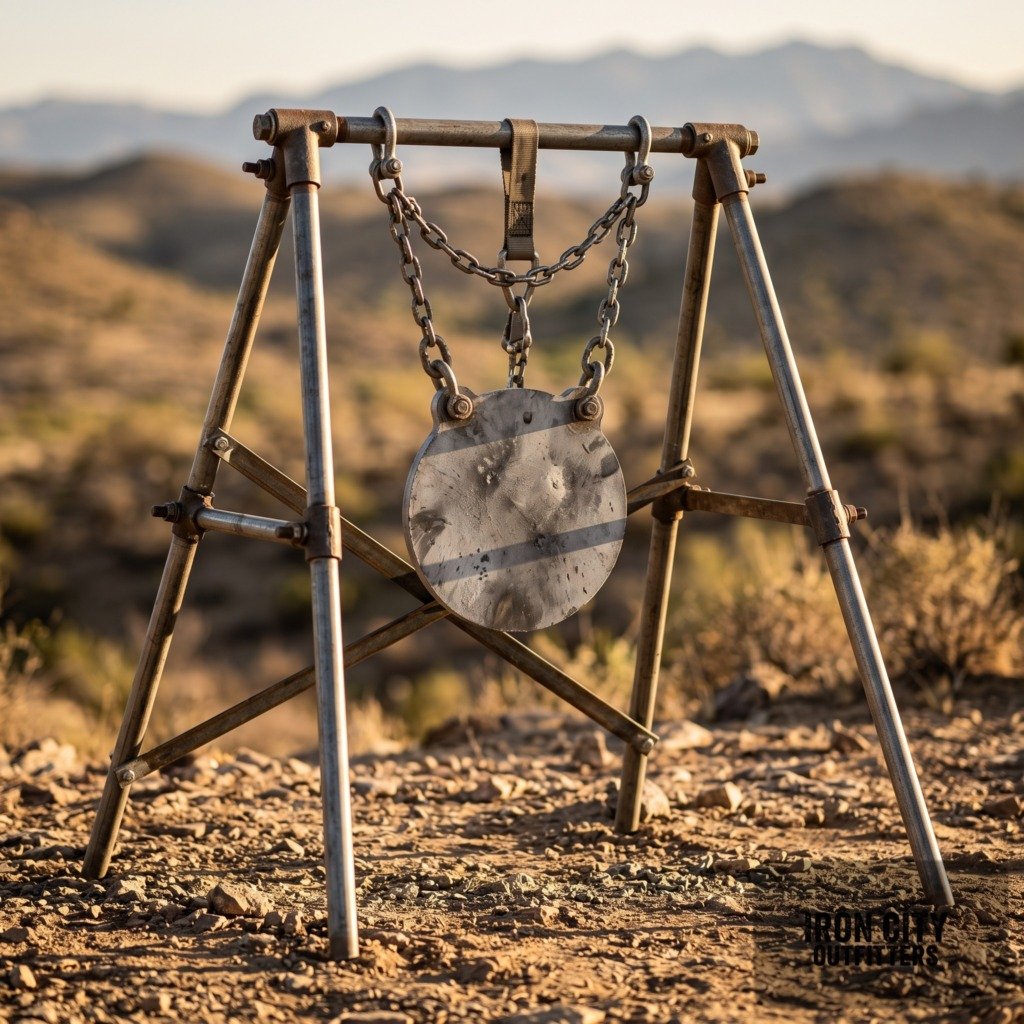
Hanging plate systems solve a problem bolted A-frame mounts cannot: energy dissipation through motion. A tripod or pyramid stand built from 1.25-inch schedule-40 conduit, cross-braced at the apex with a minimum of three grade-8 5/16-inch bolts torqued to spec, allows the plate to swing freely on impact rather than transmitting the full shock load into a rigid frame. That swing is the dampening mechanism, and its quality depends entirely on the hanger, not the stand.
Chain hangers ring. A direct steel-on-steel chain link against an AR500 plate transmits high-frequency harmonic vibration back through the mounting eye, accelerating weld fatigue and eyelet elongation within a few thousand rounds. Polyurethane or rubber-coated strap hangers absorb that same vibration at the point of contact, cutting perceptible ring time by more than half and extending hardware service life accordingly. Any hanging configuration built for sustained pistol-caliber use should specify coated strap over bare chain at the plate connection point, reserving chain only for the load-bearing suspension above the dampener.
Plate specification does not flex: 3/8-inch AR500 minimum for pistol calibers, 1/2-inch for rifle calibers exceeding 3,000 feet per second. Standoff distance scales directly with muzzle energy — 10 yards minimum for standard-pressure 9mm and .45 ACP, 15 yards for +P loads and .40 S&W, and never inside 25 yards for any centerfire rifle cartridge regardless of plate hardness. Downward cant of 15 to 20 degrees from vertical redirects spall toward the ground and away from the firing line; a plate hung dead vertical is a plate that returns fire.
No stand geometry substitutes for procedure. Every muzzle stays pointed in a safe direction. Every trigger finger stays off the trigger until sights are on target. Every firearm is treated as loaded. The target is confirmed, and what lies beyond it is confirmed twice.
Assisted by AI; content may contain inaccuracies.