
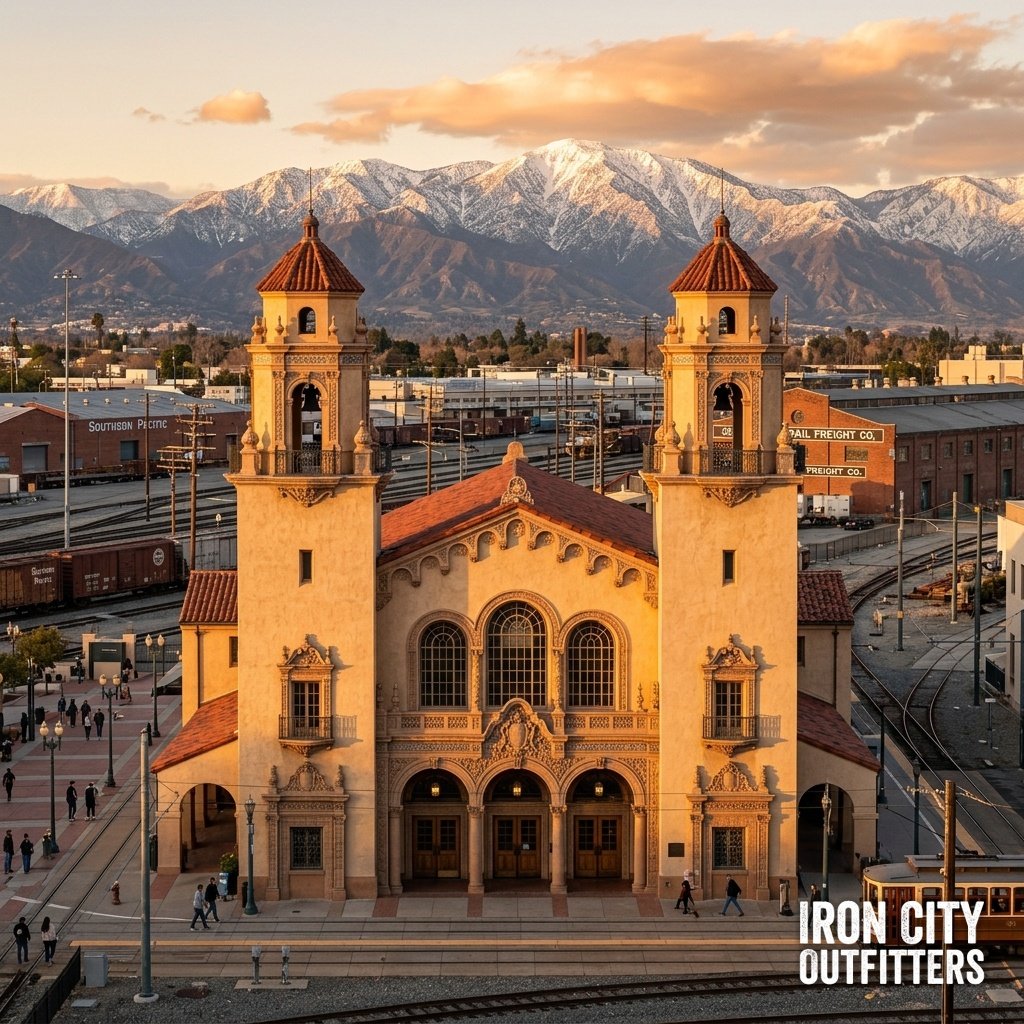
Granite peaks hem the valley in raw, unbroken stone, but two miles from the base of the Wasatch, brick and steel hold a different kind of geology — one poured, riveted, and laid by hand more than a century ago. Where the mountains offer erosion measured in millennia, Ogden’s rail corridor offers erosion measured in freight schedules, strikes, and the slow abandonment of a route once central to the American West. The contrast lands immediately: wilderness at the edge of vision, industry at the edge of the sidewalk.
Ogden Union Station anchors 25th Street at the base of that same range, a Spanish Colonial Revival terminal rebuilt in 1924 after fire destroyed its Victorian predecessor. Twin towers frame a barrel-vaulted concourse, its ceiling ribbed in dark timber and its walls finished in a warm ochre stucco that catches late sun through arched clerestory windows. Cast-iron chandeliers hang at even intervals down the nave-like hall, a deliberate echo of ecclesiastical architecture applied to a building built for freight tonnage and passenger counts rather than worship.
Beyond the main hall, rail yards stretch north in parallel lines of rust-streaked steel, a working reminder that Ogden once carried the title “Junction City,” where the Union Pacific and Central Pacific dispatched trains east and west across the continent. Warehouses along Wall Avenue retain loading docks and freight doors, brick facades weathered to a deep red-brown, window bays bricked or boarded in irregular patterns that trace decades of adaptive reuse. Grain elevators and water towers punctuate the skyline at intervals, industrial verticals standing against the horizontal sweep of the Wasatch Front.
Inside the station, permanent collections now occupy former ticketing halls — classic automobiles, firearms, and natural history specimens arranged beneath the original vaulted ceiling, a layered timeline where transportation history, craft, and regional identity intersect under one roof. Streetlamps along 25th Street cast an amber glow onto storefronts once occupied by rail workers, gamblers, and merchants during Ogden’s rougher railroad-era decades, brick facades preserved even as commerce inside has shifted toward galleries, breweries, and restaurants.
Structural permanence defines the site: reinforced masonry, deep foundations set against seismic activity, and a roofline engineered to shed heavy mountain snowpack. Ogden Union Station stands as a fixed point between wilderness and commerce, a monument to the engineering ambition that once threaded steel through granite and left behind a corridor still legible, still standing, still worth the walk from the trailhead.
Assisted by AI; content may contain inaccuracies.